
WHITEPAPER | DiALOGiFY
First-party data without your own checkout
Turn direct interactions into usable buyer knowledge
For CRM, digital and consumer engagement teams in Swiss FMCG
Scroll the figure sideways or open the enlarged version.
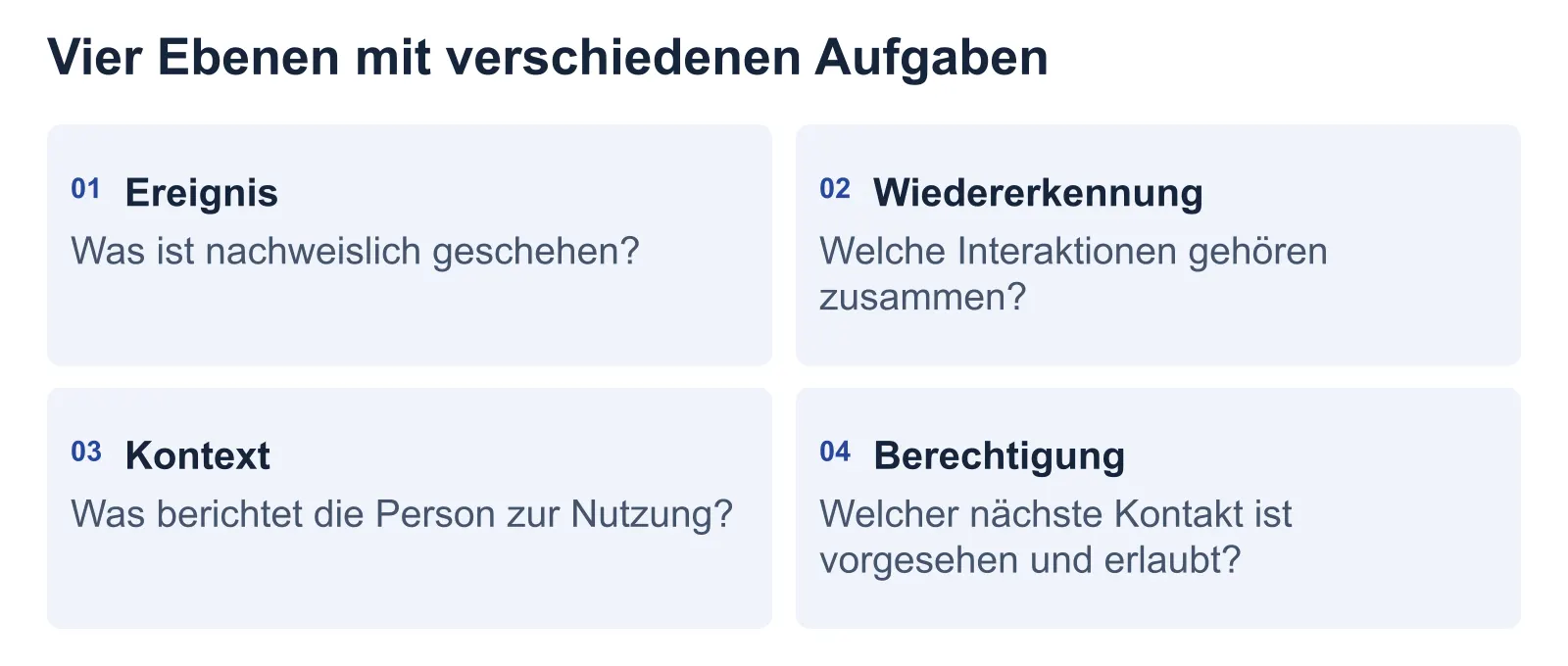
Image description and translated labels
Four levels with different tasks. Event: what demonstrably happened? Recognition: which interactions belong together? Context: what does the person report about use? Permission: which next contact is intended and permitted? Schematic illustration without performance values.
The key decisions
- Even without its own checkout, a brand can build direct buyer context.
- Event, recognition, context and permission serve different tasks.
- The relationship check helps connect a specific data gap with an owner and a next action.
The examples are schematic planning aids. They do not show achieved customer results.
The checkout belongs to the retailer. The relationship need not.
Saturday, 10:42 a.m. A consumer stands at the shelf, compares two products and chooses one. A few minutes later, the checkout system knows the product, price and purchase time. The brand, by contrast, often knows only that something was sold somewhere in the market. It knows neither the specific purchasing moment nor the reason for the choice, let alone what happens after first consumption.
This is where the real FMCG data gap arises: not because no data exist, but because the brand usually builds no direct relationship at the moment when interest becomes behaviour. Retailers control checkout. The brand therefore needs to create its own voluntary and relevant route to the buyer.
The aim is not to collect as many records as possible. It is a relationship that does three things at once: makes a real market response traceable, provides context for better decisions and opens up a useful next contact with clear permission.
The central argument
A brand does not need its own checkout to build a direct buyer relationship. It needs a valuable entry point at the real purchase or usage moment, clear separation of recognition and consent, and a data model that turns individual interactions into learning useful for decisions.
This whitepaper explains
why retail distribution and a direct buyer relationship are not contradictory,
what makes a promotion more than a lead form,
which data are genuinely relevant to decisions and which merely increase data volume,
how identity, consent, Buyer Signals and follow-up contacts work together,
and how DiALOGiFY makes this architecture practical in the market as a managed programme.
1. The problem is not the missing checkout. It is the missing relationship.
Traditional retail and campaign data answer important questions: how much was sold? When? Where? At what price? But they explain only partially why a person chose the product, in which context they use it, which alternatives mattered or what might prompt another purchase.
CRM teams feel the consequences immediately. Reach can be bought. Visibility can be reported. But without a direct, recognisable connection, many buyers become invisible to the brand after the shelf. This makes more than personalised communication difficult: it also separates activation, insights and repeat purchasing.
The decisive strategic question is therefore not: how do we obtain more email addresses? It is: how does a real retail moment become a relationship with recognisable value for consumer and brand?
First-party data do not arise from owning the checkout system. They arise when a brand collects data through a direct interaction, makes the purpose transparent and brings the information into a defined use case in a controlled way. Such a learning base reduces dependence on aggregated retail and platform data: the brand can improve activation, innovation and repeat purchasing from its own evidence, and make decisions with retailers and partners with a clearer understanding of buyers.
2. First-party data are not an address list
An email address is a contact point. It is not yet a buyer relationship. Nor does a single scan or competition entry alone prove purchase, use or future relevance.
A robust first-party relationship emerges only from the interaction of four levels:
1. Real event
A scan, proof of purchase, product registration, participation or documented use forms the starting point. What matters is what the event actually establishes, and what it does not.
2. Recognition
Recognition connects interactions over time, for example through a persistent user reference. Contacts can thus be linked to the same person or a pseudonymous profile. This does not yet create permission for marketing communication.
3. Context
Buyer Signals explain the situation behind the event, such as purchase motivation, consumption occasion, usage context, relevant substitutes, preferences, feedback or repeat purchase patterns. The number of questions is not decisive; their contribution to a specific growth or CRM decision is.
4. Permitted follow-up action
Only a clearly defined next step makes the relationship operational: relevant feedback, a service, invitation, information or nudge. Purpose, channel and consent are checked separately; technically possible recognition does not replace required communication permission.
Four levels of a usable buyer relationship
A relevant event provides the starting point. Recognition connects contacts over time. Buyer Signals add context. Appropriate permission is added for an intended follow-up contact.
Events and context can already enable a bounded analysis. Recognition is needed to connect interactions over time. Appropriate permission is added when the brand plans a follow-up contact. Which levels are needed therefore depends on the specific question.
A schematic example
A drinks brand wants to know for which occasion its product is chosen. A schematic record connects five details: valid purchase-linked participation, event date, pseudonymous user reference, the voluntary answer “on the go” and documented permission for the intended marketing contact. This leads to a specific action: for eligible contacts, the team tests an on-the-go usage idea against its previous messaging. It records feedback and confirmed follow-up purchases separately. The user reference enables linking within the agreed setup. Event, self-report, recognition and permission remain distinguishable in the profile.
3. Relationship architecture: from moment to learning system
The architecture does not begin in CRM. It begins where a person has a plausible reason to interact with the brand.
Step 1: a relevant entry point
The entry point may connect with packaging, sampling, promotion, purchase, product use or service. It must fit the situation and convey immediate value, not merely the prospect of later advertising.
Step 2: value first, then depth
The first interaction should be as easy as possible. The more effort or personal information requested, the clearer the value in exchange must be. Personalisation research shows that overt data collection and trust signals can improve responses to personalised communication, whereas covert collection heightens vulnerability and rejection.
Step 3: design identity and consent separately
A person may be technically recognisable without having consented to marketing communication. Valid consent can enable an appropriate follow-up contact. Consistent linking also helps account for earlier interactions when learning and planning further contacts. Good architecture therefore separates identity logic, transparency, purpose, consent and channel choice clearly.
Step 4: collect only signals that improve a decision
Every question should have a consequence. If an answer improves neither segmentation, offer logic, product decisions, communication relevance nor measurement, it does not belong in the flow. Data minimisation is therefore not just a data protection principle, but a quality filter for better journeys.
Step 5: connect relevant interactions in a consistent profile
For each event and answer, record when it arose, which campaign it belongs to and where it came from. The same terms must retain the same meaning across programmes. Relevant interactions can then be connected within the agreed setup into a consistent profile and a growing learning base. Which interactions can be linked to the same person and used for which purpose is defined for the setup. A voluntary answer remains distinguishable from an observed event or one confirmed against a verification rule.
Step 6: translate learning into a next decision
Value is not created by storage. It is created when signals improve the next decision: which message is relevant? Which segment needs a nudge? Which product or campaign hypothesis should be tested next? Which insight belongs in CRM and which only in campaign analysis?
4. Four data sources, four kinds of evidence
The four levels complement each other. What matters is using every source only for the question it can actually answer.
Checkout and sell-out data
They show sales, price, timing and point of sale, plus basket or customer linkage depending on the system. They are strong for transaction visibility and retail management; they do not automatically explain motivation, consumption occasion or use.
Campaign and activation data
They show the entry point, timing and course of an interaction. Their evidential strength depends on whether the market response was verified, observed or self-reported.
Buyer Signals
They add context to behaviour: purchase motivation, consumption occasion, usage situation, relevant substitutes and repeat purchase barriers. Activity thus becomes an interpretable signal.
Responses to follow-up contacts
They show which messages, timing and offers resonate. Repeated interactions become a learning base when events, attributes and permissions are maintained consistently.
Scroll the figure sideways or open the enlarged version.
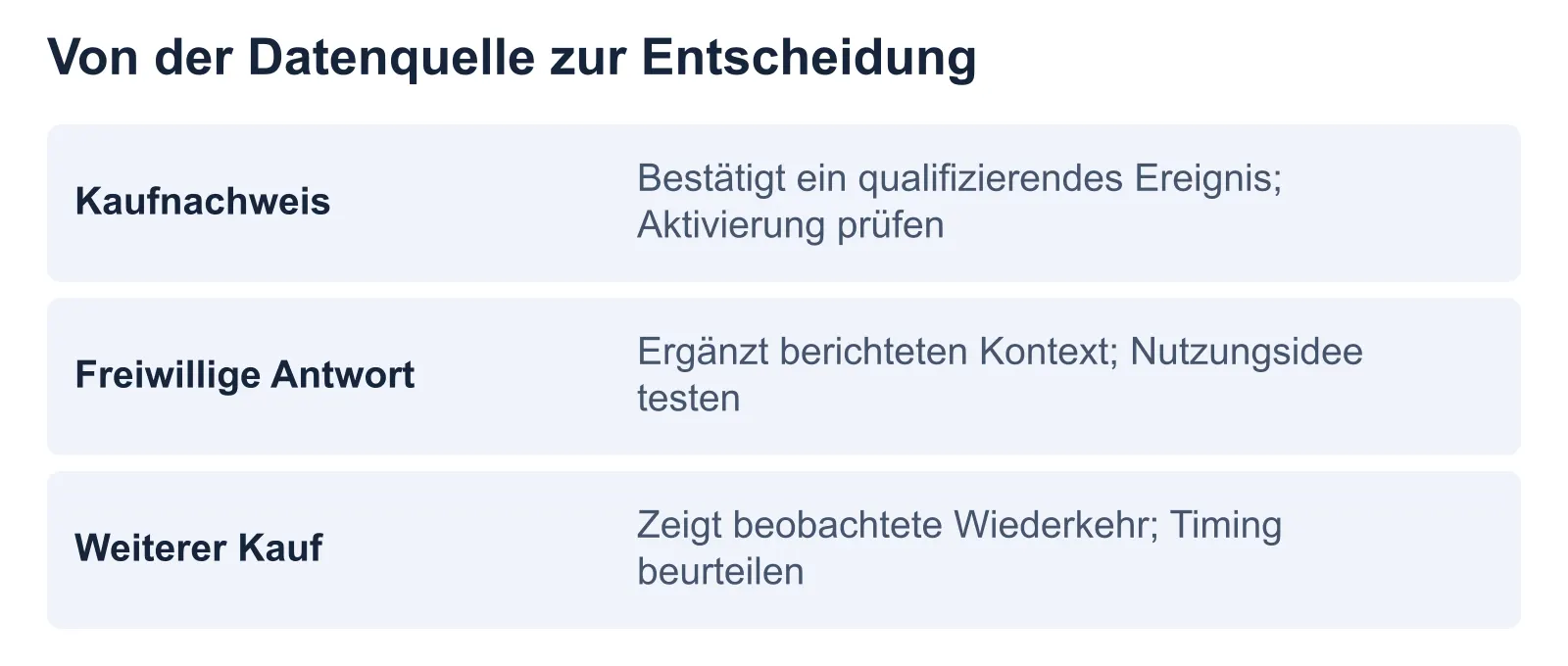
Image description and translated labels
From data source to decision. Purchase evidence: confirms a qualifying event; assess activation. Voluntary answer: adds reported context; test a usage idea. Further purchase: shows observed return; assess timing. Schematic illustration without performance values.
The most important rule: a data point may establish only what its collection logic supports. A scan is not a purchase. Participation is not loyalty. Stated intention is not repeat purchase. But together, properly collected signals can create a much better decision picture than isolated campaign reports.
Data from active buyers provide specific insights into use, communication and further tests. How far these findings can be transferred to other buyers depends on the group reached and the use case. Confirmed follow-up purchases show the return observed within the configured mechanism. A purchase outside this mechanism may remain invisible.
5. Four questions before every first-party initiative
1. Why should someone start the interaction?
The value in exchange must be specific: immediate benefit, reward, service, co-creation, relevant feedback or access. An abstract brand promise is rarely enough.
2. Which decision should the signal improve?
The objective is not “more data”, but a defined growth question. For example: which first-time buyers need support? Which usage situations open up new segments? Which substitutes threaten repeat purchasing?
3. Which permission does the next step require?
Identification, feedback, profiling and communication serve different purposes. Responsibility, information, intended use and required consents are clarified for the specific process. The FDPIC explains that the duty to inform is intended to enable transparent data processing and the exercise of data subjects’ rights.
4. Who uses the insight, and when?
Without operational ownership, first-party data end at reporting. Before launch, define which teams receive which signals, which decisions follow and how CRM, analytics, consumer care and brand management work together.
6. The first-party relationship check
These fields can be completed directly for your next specific use case. Add an owner and a deadline for every open point.
Wide tables can be scrolled sideways.
Review field | Answer and next step |
|---|---|
Entry point and value exchange | Why does the person start the interaction, and what benefit do they receive? |
Evidence | Which events are confirmed, observed or merely reported? |
Recognition | Which interactions must be linked for the specific question? |
Permission | Have purpose, information, channel and required consent been clarified? |
Relevant signals | Which decision does every collected answer improve? |
Follow-up step and learning | Which next step makes sense, and how is its result used? |
Responsibility | Who closes which data or execution gap by when? |
An open field shows what still needs clarifying before implementation. That is precisely the check’s value: it shows whether an initiative merely generates contacts or can build a learning buyer relationship.
7. How DiALOGiFY makes this architecture workable
DiALOGiFY connects physical reality, digital activation and a consistent learning model in a managed programme. Not every initiative needs every level. What matters is the combination that fits the growth question.
Physical Reality and Verified Activation: two connected levels
Physical Reality makes distribution, availability and the specific retail touchpoint visible. Verified Activation creates a traceable entry into dialogue from this and, where the use case requires it, confirms purchase or participation through a suitable mechanism. Evidential strength remains visible in the data model.
Consumer Promotion as the relationship starting point
A time-bounded Consumer Promotion can combine collecting, gamification, Instant Win, a competition or targeted feedback. Its purpose is not to stack as many mechanisms as possible, but to create a suitable interaction with a clear next step.
Buyer Signals as the context layer
Buyer Signals tailored to the product, segment and growth question explain the moment behind the activation. They are not an isolated add-on product, but the insight layer between interaction and decision.
Relevant follow-up contacts as the next step
Relevant follow-up contacts respond to a known need, for example with feedback, information, an invitation or a nudge. For marketing messages, the required consent, suitable channel and responsibility for sending are clarified in advance.
Growth Cockpit as the decision layer
The Growth Cockpit connects activation, signal and response data with specific Next Best Actions: which buyer group needs which prompt, which timing should change and which activation should expand? The views and metrics defined for the programme provide the basis for these recommendations.
Optional integration
Where useful, approved data and insights can be passed to existing CRM, analytics or marketing systems. Integration is an optional programme level, not automatic and not a substitute for clear data and process ownership.
8. From first contact to your own learning curve
The real strategic shift is small in wording but large in effect: a brand no longer waits solely for retailers, panels or campaign reports to explain what happened in the market. It builds its own direct evidence layer step by step.
The first contact need not do everything. It must be sound enough to justify the next step. With every further interaction, the brand can better understand which buyer groups respond, which contexts matter and which prompts change behaviour. Shared definitions and consistent provenance make these findings comparable across programmes. Empirical research in a digital travel setting illustrates that connecting interactions from current and previous customer journeys can improve preference predictions; the specific effect size cannot be transferred to FMCG, but the principle of a growing learning base can.
The synthesis
Checkout stays with the retailer. But the brand can build its own relationship at the real purchase and usage moment if it puts value before questions, separates recognition and consent, collects only decision-relevant signals and translates every learning into a defined next step.
Next step
The starting point is not the choice of a tool, but the question: who owns the buyer relationship today, and where does it break down?
In a focused Discovery Call, we assess the entry moment, data quality, Buyer Signals, permissions and next useful step for a specific use case. The result is an initial relationship architecture rather than another isolated campaign.
Sources
FDPIC. Duty to inform. Explanations on transparent collection and processing of personal data.