
WHITEPAPER | DiALOGiFY
The second purchase decides
Identify repeat purchase barriers and test the right next step
For brand and product management teams in Swiss FMCG

The key decisions
- A good product experience does not automatically lead to the next purchase.
- Use, everyday relevance and purchase opportunity require different tests.
- The repeat purchase map turns an assumption into a bounded pilot with clear measurement points.
The examples are schematic planning aids. They do not show achieved customer results.
The moment when the second purchase is lost
Wednesday evening. The new product is opened, tried and liked. Two weeks later, the same person stands at the shelf again. They remember the taste, see the familiar alternative, pick it up and move on. The first purchase is documented. The lost second purchase is not.
For the brand, the launch still looks successful: samples distributed, activations achieved, cashback redeemed, dialogues completed. The report ends the story exactly where it begins for growth.
Between “liked it” and “bought it again”, there is no automatic loyalty, but a series of small everyday decisions. Perhaps the right usage idea was missing at the decisive moment. Perhaps a preparation question remained unanswered. Perhaps the familiar alternative was mentally closer, physically more visible or simply easier. And perhaps the brand knew none of this.
The first purchase already contributes to growth. Further development depends on whether the product is chosen again. Between these events lies an often poorly managed phase of the customer journey. Brands invest heavily in reach, trial and first purchase. Silence often follows, even though this is precisely when it is decided whether the product earns a place in everyday life or drops out of consideration at the next need.
The central argument of this whitepaper is therefore that failure to return can have different causes: product experience, missing everyday relevance or an unfavourable next purchase opportunity. Distinguishing these barriers makes it possible to test the right lever. Repeat purchasing becomes a systematic task when the gap is made visible, the next step is tested purposefully and return is measured clearly.
DiALOGiFY connects identifiable activation, Buyer Signals, relevant follow-up contacts and measurement in a learning and repeat purchase approach. Not every brand needs every stage at the same depth. What matters is identifying the right barrier and deriving a verifiable next decision.
1. A good experience is not yet a repeat purchase
People can like a product and still choose something else on their next shopping trip. Purchasing and consumption do not happen in a vacuum. Habits are activated by recurring contexts and can remain stable even when a person is generally open to an alternative.
This does not yield a simple formula in which any communication breaks habits. On the contrary: a single prompt replaces neither product quality nor availability, value for money or a convincing usage moment. But it can help make a relevant reminder, application or decision available in the right context.
The customer journey does not end at purchase either. Customer experience research describes it as a sequence of touchpoints before, during and after the transaction, shaped partly by the brand and partly by partners, retailers or consumers themselves.
For brands, the practical implication is that first contact must not be treated only as campaign closure. It starts a new question: what should happen between first experience and the next purchase opportunity for the product to become relevant again?
What first contact shows and what remains open
Wide tables can be scrolled sideways.
Observable event | What it shows | What it does not prove |
|---|---|---|
Sample handed out | The product was made available | That it was used or purchased |
Qualifying purchase confirmed | A qualifying purchase occurred within the mechanism | That the person had never bought before |
Positive feedback | The person reports a good experience | That another purchase will follow |
Follow-up prompt delivered | The planned communication was delivered | That it changed the purchase decision |
Further purchase observed | A later qualifying transaction was linked | That it would not have happened without the activity |
This separation is not academic caution. It prevents a campaign from being called a growth system prematurely after the first measurable event.
2. The invisible phase between purchase one and purchase two
Several decisions take place between first product experience and repeat purchase. Some are conscious, many incidental. They often remain invisible to the brand because sell-out data show the result but do not reliably explain what happened in everyday life in between.
First consumption tests the promise
At first consumption, communication meets reality. Taste, handling, dosage, effect, packaging and expectations are tested in a specific moment. Even a good product can lose out through incorrect use, missing guidance or an unsuitable frame of expectation.
The product needs a role in everyday life
For repeat purchase planning, it is useful to ask for which specific task or situation the product should become relevant again. The Jobs-to-be-Done perspective focuses on when it is chosen and which alternatives it actually competes against there.
At the moment of consumption, a snack may compete not just with other snacks, but with skipping the snack altogether. Depending on the situation, a drink competes with water, coffee or a familiar routine. These substitutes are easily missed in conventional category analysis.
The next purchase decision happens under different conditions
At the next shopping trip, price, availability, visibility, memory, habit and current need interact. A positive product experience in the past is only one signal among several. The second purchase must therefore be understood as a new decision, not an automatic consequence of the first.
This reflects the basic insight that brand growth requires both mental and physical availability. A product must be remembered at the relevant moment and accessible in the actual purchasing environment.
Three typical repeat purchase losses
Wide tables can be scrolled sideways.
Loss point | Typical pattern | Decisive learning question |
|---|---|---|
Usage gap | The product was bought but not used appropriately or fully | What happened at first consumption, and which barrier remained? |
Context gap | The product was liked but gained no clear place in everyday life | At which moment and for which task should it become relevant again? |
Decision gap | The next need arises, but the habitual alternative wins | What must be mentally and physically available at the next purchasing moment? |
3. Five unknowns that determine purchase two
A repeat purchase strategy does not start with a message. It starts with five questions showing where and why the path to the second purchase breaks down.
What was the first qualifying contact?
A distributed sample, confirmed purchase, cashback participation and completed dialogue are different starting points. The programme must define which event starts observation.
When and how was the product used?
Consumption occasion and usage context give meaning to the purchase. They show whether the product reaches the intended situation or creates value at an unexpected moment. This information can be collected voluntarily in the dialogue; it must be distinguished from observed system events.
What made use easier or harder?
After the expected consumption time, Conversational Feedback can ask a few targeted questions: was the product used? What impressed? What remained unclear? Which alternative would otherwise have been chosen? The aim is not maximum data collection, but a better next decision.
When does the next real purchase opportunity arise?
The repeat purchase window depends on category, pack size, household consumption, occasion and use. A prompt that arrives too early is irrelevant. One that arrives too late may reach the person only after the habitual alternative has already been bought again.
Which event counts as a repeat purchase?
A repeat purchase needs an operational definition: the same person or permitted recognition, qualifying product or assortment, confirmed event and a fixed observation window. Repeat purchase intention is not observed repeat purchase. A second participation can be interpreted as another purchase only if the mechanism actually supports this conclusion.
4. From product experience to a systematic repeat purchase approach
The five unknowns can be translated into a connected working approach with five stages. Not every project needs every stage to the same extent; selection follows the specific growth question and diagnosed loss point.
1. Identifiable entry point
A suitable activation creates a defined starting point, such as a Consumer Promotion or Digital Sampling with Instant Cashback. A repeat purchase nudge is standard with Instant Cashback through TWINT. Further feedback and contact sequences are planned for the use case. Only the event actually confirmed by the specific mechanism becomes visible.
2. Buyer Signals relevant to decisions
A few voluntary answers provide context on motivation, consumption occasion, usage situation, barriers and relevant alternatives. Buyer Signals are a layer for learning and decisions, not an end in themselves.
3. Feedback after use
An appropriately timed dialogue asks whether and how the product was used. Responses help distinguish product problems, comprehension issues and missing everyday relevance.
4. Relevant follow-up contact
The next prompt follows moment, need and purpose. It may offer usage help, inspiration, feedback or a reminder during the repeat purchase window. Communication takes place only within the intended permission and channel framework.
5. Measurable follow-up event
The programme observes the defined next action. Repeat purchase, Time to Repeat and response to the follow-up prompt are assessed with a clear population and time basis.
Scroll the figure sideways or open the enlarged version.
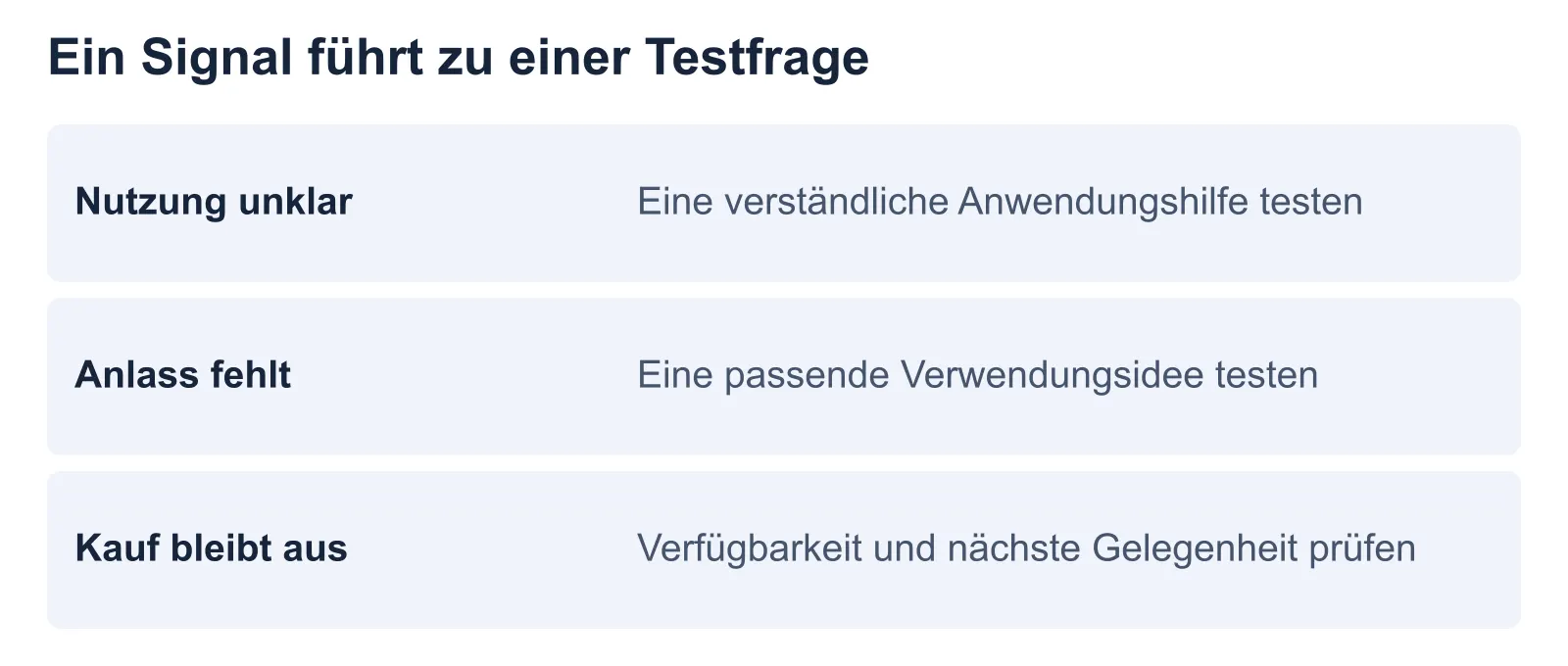
Image description and translated labels
A signal leads to a test question. Use unclear: test clear usage guidance; Occasion missing: test an appropriate usage idea; Purchase fails to occur: check availability and the next opportunity. Schematic illustration without performance values.
This architecture deliberately makes no claim of linear success. Every stage can provide insights without the next effect occurring automatically. Its value lies in making uncertainty visible and choosing the next test purposefully.
5. Relevance beats message volume
Between purchase one and purchase two, the aim is not as many contacts as possible. It is a plausible next touch. A relevant touch connects moment, human need, purpose, trigger, content and channel. The nudge does not creatively reinvent this touch; it translates it into a specific message with exactly one next step.
Wide tables can be scrolled sideways.
Moment | Possible purpose | Example |
|---|---|---|
Immediately after entry | Guidance and reassurance | Brief confirmation and clear information on further participation |
Before or during first consumption | Usage help and product education | Preparation, application, dosage or a suitable usage idea |
After expected consumption | Learn and understand barriers | Brief Conversational Feedback on the actual usage experience |
Within a plausible repeat purchase window | Reminder and renewed relevance | Occasion-based inspiration or repeat purchase nudge |
After an expected return fails to occur | Test the hypothesis or reactivate purposefully | Test, only within the permitted framework, whether need, timing or barrier were misjudged |
The channel is not the strategy. Email, WhatsApp or another delivery method are simply routes. What matters is why this content might be useful to this person at this moment.
A touch is not proof of impact either. Its relevance is shown only by an observable outcome or a properly collected signal. Delivered messages, opens and clicks may be intermediate events; they do not replace the defined business outcome.
6. Not every repeat purchase gap needs a nudge
Every repeat purchase gap needs the right diagnosis. Communication is not the right main action when:
the product fails to convince at first consumption or has significant quality problems
distribution and shelf availability prevent the next purchase
price or pack size do not fit the actual usage situation
the category has no meaningfully definable repeat purchase window
there is no permitted identification or permission for the planned follow-up contact
This diagnosis is exactly what makes Buyer Signals valuable. They show not just which message might work, but whether product, sales, assortment or activation must change first. The strength lies not in treating every gap as a communication problem, but in making the right next lever visible.
7. Measure repeat purchasing without inventing impact
Repeat purchase measurement becomes robust when five definitions are fixed before launch:
Population: which people or purchases belong in the starting group?
Starting point: which event initiates observation?
Follow-up event: which later purchase or participation is recognised?
Observation window: from when and for how long is return measured?
Comparison basis: against what is the observed outcome interpreted?
Core metrics
Wide tables can be scrolled sideways.
Metric | Working definition | Use |
|---|---|---|
Repeat purchase rate | Share of buyers with at least one further confirmed purchase within the defined period. Count people with a confirmed starting purchase whose full measurement period has already elapsed. | Shows observed return within the measurement model |
Time to Repeat | Time from the confirmed starting purchase to the next observed qualifying purchase. Report together with repeat purchase rate and measurement period. | Helps with timing. People without an observed follow-up purchase are not included in this time measure. |
Touch response | Defined behaviour following a specific follow-up prompt | Shows an observed response after the prompt |
Incremental impact | Additional impact estimated using an appropriate comparison design | Helps assess the activity’s contribution; explanatory strength depends on the comparison design |
Observed repeat purchasing and incremental lift are not the same. Another purchase may be clearly observed without proving the follow-up prompt caused it. An impact claim needs an appropriate comparison basis.
Likewise, self-reported repeat purchase intention, further participation, another purchase and repeat purchase of the same product must not be confused. Measurement must fit the specific claim.
Data from active buyers provide specific insights into use, communication and further tests. How far these findings can be transferred to other buyers depends on the group reached and the use case. Confirmed follow-up purchases show the return observed within the configured mechanism. A purchase outside this mechanism may remain invisible.
8. The repeat purchase map
The following map translates this whitepaper into an initial working hypothesis. Brand, product, trade and insights teams can complete it together before a pilot. Unclear fields are not a weakness; they show what the pilot must learn.
Schematic example of a completed row: for a breakfast product, the reported barrier is “Preparation takes too long in the morning”. The next test offers an idea for preparation the evening before. Voluntary feedback shows whether this makes use easier; a further confirmed purchase within the defined period is recorded separately. Feedback and purchase thus answer different questions.
Wide tables can be scrolled sideways.
Work area | Guiding question | Working hypothesis |
|---|---|---|
Starting event | Which first contact or purchase is clearly defined? | Confirmed starting purchase of a breakfast product; consistent product and participation rule. |
Consumption occasion | When, where and for what should the product be used? | Quick breakfast at home on weekdays. |
Relevant alternative | What else would the person choose or do at this moment? | Familiar bread or another readily available breakfast. |
Main barrier | What might prevent use, recall, availability or another purchase? | Reported preparation time in the morning; test as a hypothesis. |
Repeat purchase window | When does the next purchase opportunity realistically arise? | Four weeks from starting purchase for this planning scenario; check against pack size and use before testing. |
Next touch | Which helpful prompt fits the moment, need and purpose? | For eligible contacts, test an evening-before preparation idea against the previous messaging; assign groups randomly where possible. |
Follow-up event | Which behaviour should be observed, and how should it be interpreted? | Record usage feedback and a confirmed follow-up purchase within four weeks separately. |
Decision rule | Which outcome leads to scaling, adjustment or stopping? | Define an economically meaningful minimum difference and required sample size in advance. Continue with a robust result; if unclear, review measurement or the hypothesis. |
9. How DiALOGiFY makes repeat purchasing diagnosable and manageable
DiALOGiFY starts before the repeat purchase nudge. Its strength lies in connecting activation, Buyer Signals, relevant follow-up contacts and measurement so that the main repeat purchase barrier becomes visible and the right next lever can be tested.
Activation creates the starting point. Depending on the task, a Consumer Promotion or Digital Sampling with Instant Cashback can create a defined entry event that can be confirmed within the mechanism.
Buyer Signals explain context. Voluntary information on motivation, consumption occasion, use, barriers and alternatives turns an anonymous transaction into a better basis for decisions.
Conversational Feedback closes the usage gap. A few targeted questions after expected consumption help distinguish whether product, application, expectation or situation influences the next purchase.
NudgeFlow translates relevant touches into permission-based message sequences that build on each other. The series follows a narrative arc rather than a list of isolated messages: every contact picks up the existing context, delivers specific value and leads to exactly one appropriate next step. Timing, triggers, channel, frequency and stopping conditions are defined for each project.
The Growth Cockpit makes learning useful for decisions. It combines the activation, Buyer Signal, touch and repeat purchase data available in the project into one measurement and decision view. Repeat purchase rate and Time to Repeat are central. Analysis by campaign, buyer group or region helps identify where adjustment is useful. Clear definitions and visible sample sizes make results understandable.
The Customer Momentum System connects these levels from identifiable entry to the next measurable decision. The data, contacts and analyses included in the programme are defined for the specific use case.
This distinguishes DiALOGiFY from a single campaign or isolated messaging tool. The aim is not more communication, but a better decision: understand first-time buyers, identify the relevant barrier, test the appropriate next step and make repeat purchasing progressively more measurable.
10. The smallest useful repeat purchase pilot
An initial pilot need not represent the entire target architecture. It must address a relevant uncertainty in a way that enables a next decision.
Seven questions should be answered before launch
Which clearly defined group starts with which event?
Which consumption occasion or barrier should be understood?
Which two to four Buyer Signals are genuinely needed for this decision?
Which follow-up prompt is tested within which time window?
Which permission and channel are intended for this?
Which follow-up event and comparison basis make the result interpretable?
Which outcome leads to scaling, adjustment or stopping?
This discipline prevents a pilot from having to prove CRM development, product research, sales promotion, brand attachment and loyalty all at once. A clear hypothesis produces a clear learning signal.
Conclusion
The first contact can create curiosity. First use can convince. A second purchase shows that the product was chosen again. It is an initial indication of its place in everyday life.
Brands lose this decision when they document only activity after trial or first purchase. They gain a better starting position when they understand consumption occasion, use and alternatives, test a relevant next step and measure return with clear events and time windows.
DiALOGiFY connects these tasks in a learning and repeat purchase approach. The path from a one-off product experience to further purchases can thus be understood and shaped progressively better.
Next step
A specific product, the expected repeat purchase window and today’s biggest blind spot between use and the next purchase decision are enough for a shared Discovery Call. Together, these starting points can be transferred to the repeat purchase map and translated into a bounded first test with clear signals, measurement points and decision rules.
About DiALOGiFY
DiALOGiFY develops the Customer Momentum System for FMCG and retail brands. It connects retail execution and the point of sale with verifiable activations, voluntary Buyer Signals, relevant follow-up contacts and repeat purchase measurement. DiALOGiFY AG is based in Zug, Switzerland.