
WHITEPAPER | DiALOGiFY
Post-Purchase Growth
Shaping growth between the first and the next purchase
For marketing managers and CMOs in Swiss FMCG

The key decisions
- Acquiring buyers remains central. After the first purchase, a targeted learning loop helps identify further purchase barriers.
- An initial pilot needs a growth question, a few relevant signals and an appropriate follow-up prompt.
- Before launch, define which observation will lead to scaling, adjustment or stopping.
The examples are schematic planning aids. They do not show achieved customer results.
The campaign ends. Learning continues.
On Monday, a new product lands in the shopping basket. A promotion, a recommendation, a moment of curiosity. On Wednesday, it is tried. It tastes good. It fits. For the brand, the story could end well here.
Yet at the next shopping trip, the familiar alternative wins.
Not necessarily because the new product was worse. Perhaps a suitable usage idea was missing. Perhaps it was unavailable on the shelf. Perhaps it simply did not come to mind at the decisive moment. The first purchase appears in the report. Why the second failed to happen does not.
The brand has invested in visibility, activation and trial. But “liked it” does not yet mean “part of everyday life”. This is precisely where a growth opportunity can disappear when a campaign closes: what happens after the first purchase, and how does the brand become relevant again when the next need arises?
The central argument of this whitepaper: the first purchase must not be the end of an activation. It must become the starting point for buyer understanding, a relevant next prompt and measurable repeat purchasing. Not instead of new buyers, but to retain more of the potential already created.
Post-Purchase Growth turns this phase into a growth discipline. DiALOGiFY connects the necessary tasks in the Customer Momentum System: activation, Buyer Signals, relevant Touch Journeys and learning from impact. A single campaign thus becomes a programme that does not start from scratch every time.
The first purchase creates potential. What matters is what the brand makes of it.
1. The repeat purchase gap: when activation ends too soon
Reach, trial and first purchase do not yet show whether a product will find a place in everyday life. Measuring only the initial reaction leaves unanswered who returns and which barrier prevents the next purchase.
When evaluating new products, NielsenIQ also considers not just trial but repeat purchasing, consumer feedback and additional category contribution. Its European launch analysis shows that curiosity can trigger the first purchase; satisfaction, quality and perceived value are central to subsequent development.
The implication: acquire no fewer first-time buyers, but make more of the first purchase. In addition to sales, an activation should leave behind buyer knowledge and a path to the next relevant moment.
More activation does not automatically mean more learning
Promotions, media, sampling and loyalty programmes can generate demand and keep brands available. The gap is not created by these tools, but where their results remain isolated: a sales peak, a redemption, a contact, without a connection to use and return.
Panel and sell-out data remain important for understanding the market and sales velocity. In retail, the transaction and much of the customer data belong to the retailer. Direct Buyer Signals give even brands without their own checkout a learning trail of their own: they complement the retail view with buyer context and create a stronger basis for activation and trade decisions. The question for your next activation is therefore not only “How many people responded?”, but “What do we know better afterwards, and what can we change with that knowledge?”
2. Brand growth needs new buyers. And a good reason to return.
Research by the Ehrenberg-Bass Institute shows that larger brands mainly have more buyers, as well as slightly higher loyalty metrics. Broad buyer acquisition remains central. Repeat purchase strategies must therefore not be limited to a few regular buyers.
Two conditions go together: physical availability, meaning the brand can be bought where the need arises, and mental availability, meaning it comes to mind or is recognised in relevant purchasing moments.
Post-Purchase Growth addresses opportunities after an activation: what helps people choose the product again when a later need arises? It complements reach, distribution and product quality. This growth logic connects the buyer base and purchase frequency; a higher repeat purchase rate alone does not guarantee revenue growth.
Three questions instead of a false either-or debate
Acquire buyers: does the brand reach enough new and light buyers, meaning people who buy it only occasionally?
Become relevant again: what helps these people choose the product again at the right moment?
Learn from impact: which activation produces not only a purchase, but a better foundation for the next one?
A product missing from the shelf cannot be fixed with a nudge. But a good usage moment need not remain unused until the next major campaign either.
3. Competition is decided in everyday life
The category describes where a product is sold. The consumption occasion helps explain why it is chosen. Both matter, but looking at neighbouring products on the shelf is often not enough for the next prompt.
The Jobs-to-be-Done perspective asks what task a product is supposed to fulfil in a specific situation. This also makes alternatives outside the product’s own category relevant.
A drink may compete with coffee in the morning, a snack in the afternoon and a dessert in the evening. This is a working hypothesis. What matters are the alternatives considered by the brand’s own buyers and observable behaviour.
The relevance of context to repeat purchasing is also shown by an analysis of 1.6 million consecutive pairs of brand choices in three FMCG categories in Germany and Great Britain: stable shopping conditions were more often associated with choosing the same brand; changed conditions could make repeat purchasing harder.
A transaction only becomes a better decision with context
A few Buyer Signals can make the difference: purchase motivation, consumption occasion, needs, usage context and relevant alternatives, tailored to the product, segment and growth question.
Voluntary information provides reported context; confirmed purchases show observable behaviour within the mechanism. Together, they offer a more informed view than the transaction alone.
Scroll the figure sideways or open the enlarged version.
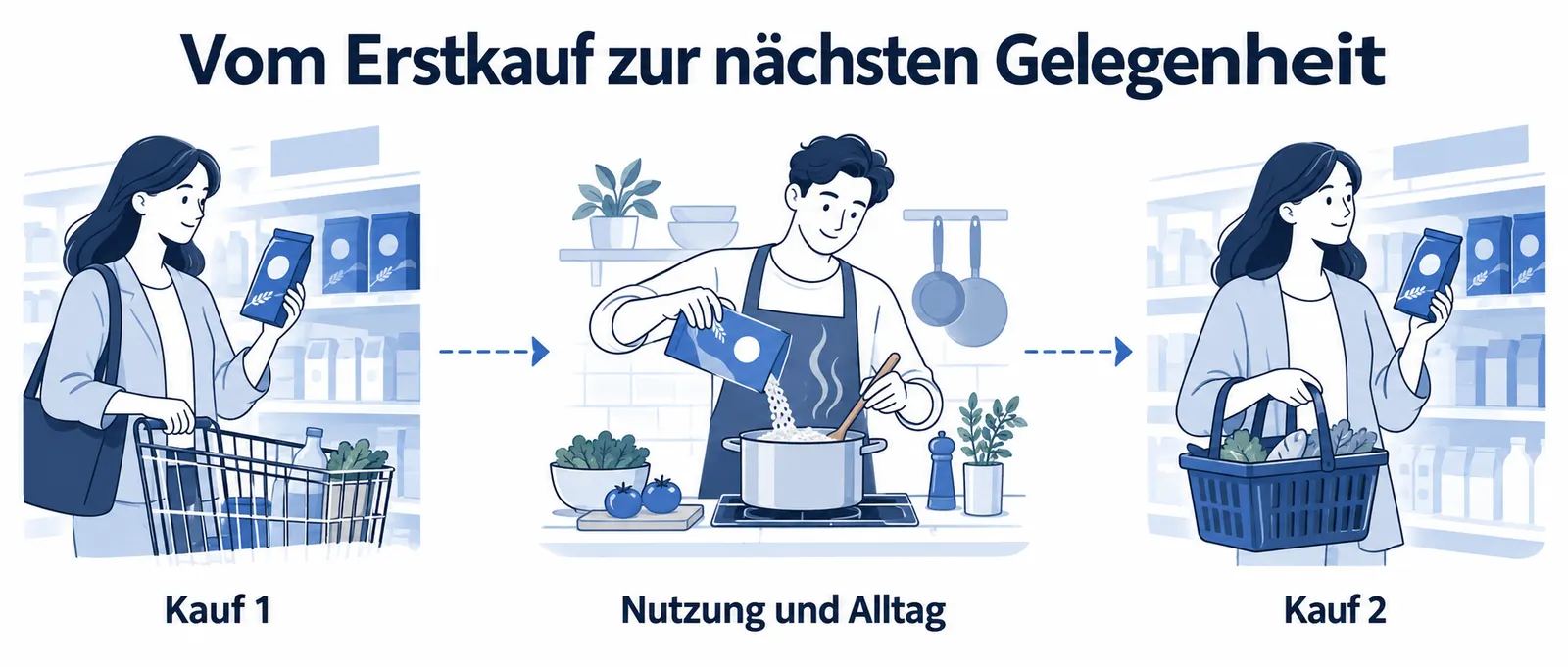
Image description and translated labels
From first purchase to the next opportunity. Purchase 1: a qualifying event as the starting point; Use and everyday life: understand experience and relevant need; Purchase 2: a further transaction within the defined window. Schematic illustration without performance values.
This view may also provide an uncomfortable answer: perhaps what is missing is not a reminder, but a better explanation of use, a more suitable format or availability. That is precisely why Buyer Signals should improve not just the next message, but product, trade and budget decisions too.
4. From a single pilot to a learning programme
A better repeat purchase approach does not first require a major platform transformation. The starting point is a specific growth question. That leads to a bounded test, and its findings determine the next step.
Phase 1: a hypothesis that changes a decision
Market data and team knowledge provide direction. For example: “The product impresses during trial, but is not remembered at the next everyday occasion.” The pilot tests this hypothesis.
Phase 2: an activation with a follow-up
A clearly defined use case provides the starting point, such as Digital Sampling with Instant Cashback or a purchase-linked promotion. Instant Cashback combines a fixed, guaranteed cashback payment through TWINT with a planned repeat purchase nudge. The activation connects a confirmed purchase with a few relevant Buyer Signals. Timing and permission for follow-up contact are defined within the intended channel framework. Purchase confirmation does not automatically mean that the person has bought the product for the first time ever.
Phase 3: translate the result into the next decision
The test indicates whether the assumption holds and which next step makes sense. Further occasions, audiences or channels build on this. Reusable signals, permitted contact opportunities and documented learnings become Customer Assets.
DiALOGiFY connects these tasks in the Customer Momentum System. Where needed, Scoutsss Services create Retail Visibility: is the product available and visible, and is the activation implemented correctly? Business Initiatives create measurable activation. Buyer Signals provide context. Touch Journeys orchestrate relevant customer moments; Nudge Flows automate specific next prompts within them. The Growth Cockpit turns learning into a basis for decisions and shows where the next action should focus.
Not every stage is needed at the start, and not every connection is already fully automated. Scope follows the growth question, not the longest possible list of modules.
What is measured
Repeat purchase rate shows observed return within a defined group and period. Time to Repeat shows the time until the next qualifying purchase. Purchase frequency adds the longer-term perspective. Revenue lift and ROI also require suitable customer, retail or PoS data and a clear cost framework.
Scroll the figure sideways or open the enlarged version.
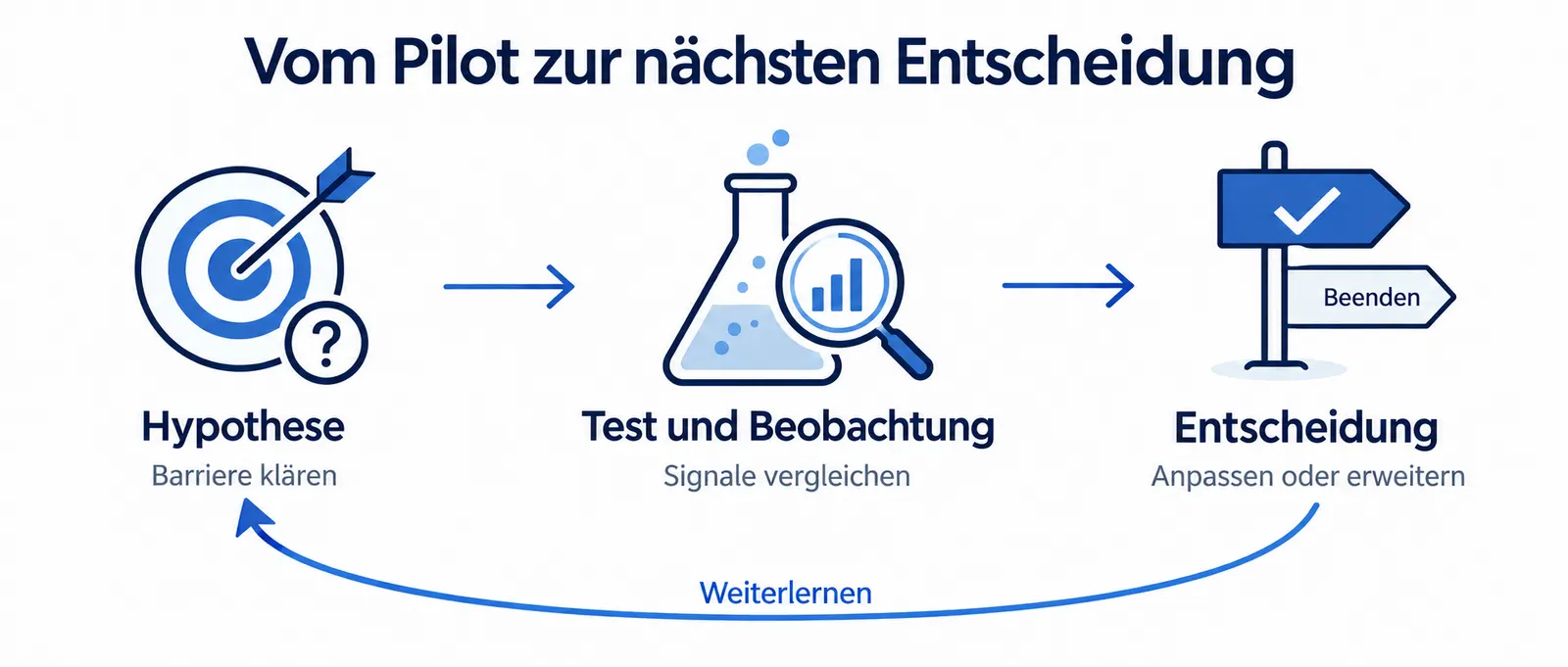
Image description and translated labels
From pilot to the next decision. Hypothesis: which barrier should the test clarify? Test and observation: record appropriate signals and comparison; Decision: expand, adjust or stop. Schematic illustration without performance values.
Observed return is not yet an additional purchase caused by the activity. A suitable control group or robust comparison basis helps assess impact rather than mere activity. Duration and measurement windows follow the product and its actual purchase frequency.
Data from active buyers provide specific insights into use, communication and further tests. How far these findings can be transferred to other buyers depends on the group reached and the use case. Confirmed follow-up purchases show the return observed within the configured mechanism. A purchase outside this mechanism may remain invisible.
A pilot that enables a next decision
Schematic planning scenario: a drinks brand suspects that its product does not find a lasting place in everyday life after the first trial. It asks participants in a purchase-linked promotion about their intended consumption occasion and the alternative considered. Responses point towards an afternoon occasion. The team tests a suitable usage idea against its previous messaging, using random group assignment where possible. It compares confirmed follow-up purchases within the same window and considers reach and costs. A robust advantage may support continuing. If the result remains unclear, the team first checks sample size, implementation and the hypothesis. Campaign closure thus becomes a justified next test.
5. Your own Buyer Signals: the context AI cannot invent for you
AI can write faster, structure data and make patterns visible. That does not yet amount to understanding your buyers. A model does not automatically know when your product is used, which alternative a person considers or what prevents the next purchase.
Your own Buyer Signals give this use of AI brand-specific context. They can help organise feedback, develop hypotheses and suggest relevant next actions. The strategic advantage lies not only in access to AI, but in the quality and usability of the buyer knowledge it works with.
More data alone are not enough. Definitions, data quality, permitted use and the composition of the participating group determine how much the findings can tell you.
The practical implication: start with signals that improve your next decision. Build the history step by step, rather than waiting until the next AI initiative to look for relevant context. Where events were not recorded, opportunities for comparison are missing; retrospective surveys can add to them, but cannot replace every observation.
AI supports learning. Strategy, brand management and approvals remain human decisions.
6. Six decisions for the next activation
These fields can be completed directly for your next specific use case. Add an owner and a deadline for every open point.
Wide tables can be scrolled sideways.
Work area | Your definition |
|---|---|
Starting question | Which barrier or growth question should be clarified? |
Existing observation | Which data are already available, and what do they actually show? |
Next test | Which action will be tested, using which few Buyer Signals? |
Measurement and decision rule | Group, follow-up event, window and comparison; when should you expand, adjust or stop? |
Responsibility | Who plans, implements and assesses the result? |
Decision timing | When will a complete observation be available, and who decides then? |
Conclusion
At the next shopping trip, the decision starts again. The brand that triggered the first purchase does not automatically receive a second.
Post-Purchase Growth turns this uncertainty into a task you can work on: acquire buyers, understand their relevant moments, shape the next suitable step and learn from its impact.
DiALOGiFY connects these tasks in a Customer Momentum Programme. Alongside the immediate result, an activation thus creates a foundation for understanding buyers better, testing the next appropriate contact and supporting further decisions with retailers and internal teams.
The first purchase is only the beginning.
Next step
What will remain of your next activation when it is over?
Bring a product, the return observed so far and the biggest open point between purchase 1 and purchase 2 to a Discovery Call. Together, we can derive an initial hypothesis: which Buyer Signals are missing, which follow-up prompt makes sense and which result would support a scaling decision.
About DiALOGiFY
DiALOGiFY AG, based in Zug, develops the Customer Momentum System for FMCG and retail brands. It connects Retail Visibility, measurable activations, Buyer Signals, Touch Journeys, Nudge Flows and the Growth Cockpit in a shared learning and repeat purchase approach.