
WHITEPAPER | DiALOGiFY
New product launches: why strong starts fade
Assess availability, use and repeat purchasing after launch
For innovation, launch and NPD teams in Swiss FMCG

The key decisions
- A good launch report does not yet show whether the product will be chosen over time.
- Availability, product experience and the next purchase opportunity are assessed separately.
- Nine questions and a next review date help address the greatest need for action early.
The examples are schematic planning aids. They do not show achieved customer results.
The launch is over. The real test begins
Monday morning, 7:30 a.m. The display is in place. The campaign is running. Sell-in is booked. The new product has its place on the shelf and in reporting. Everything points to a successful start.
But the decisive moment comes later. The product is tried at home. At the next shopping trip, the familiar alternative is beside it again. Now it is decided whether curiosity becomes another purchase. This moment rarely appears in the launch plan. It is central to business value.
Six months after launch, the launch film is history. What remains of its reach? Is the product still found, understood and bought again? And did the team adjust in time, before a small obstacle became a major sales problem?
In 2024, Promarca member companies launched 8,750 new branded products in Switzerland. A large number of new offers, but no answer yet as to which will earn a lasting place in everyday shopping.
NielsenIQ studied more than 3,500 new brands and sub-brands from 2025 in Great Britain, Germany, France, Italy and Spain. Only around one third reached one per cent household penetration; 17 per cent combined strong trial with strong repeat purchasing.
The decisive question is therefore not only: how strong was the start? But: what remains of the initial reach once attention, promotion and first curiosity fade?
A strong start creates attention. A strong launch turns it into relevant first purchases, repeat purchases and a viable business.
1. A successful start leaves important questions unanswered
Distribution, reach, promotion participation and early sell-out show that a launch has started. They do not yet answer whether the product will gain a recurring role in everyday life.
A product can be well listed and still be missing at individual locations. It can generate trial purchases yet meet a different expectation at consumption than anticipated. It can be liked and still lose to a familiar substitute on the next shopping trip.
Three confusions make these gaps difficult to identify:
Attention is not demand. A contact opens an opportunity; a purchase shows it was taken.
Purchase intention is not repeat purchase. Even honestly stated intention must still prove itself in a later shopping situation.
Reporting is not management. A change becomes useful for the business only when it leads to a next action.
NIQ identifies product quality, satisfaction and perceived value as stronger drivers of repeat purchasing than novelty alone. A launch must therefore do more than persuade people to try. It must understand what sustains the product experience and what makes the next purchase easier.
Scroll the figure sideways or open the enlarged version.
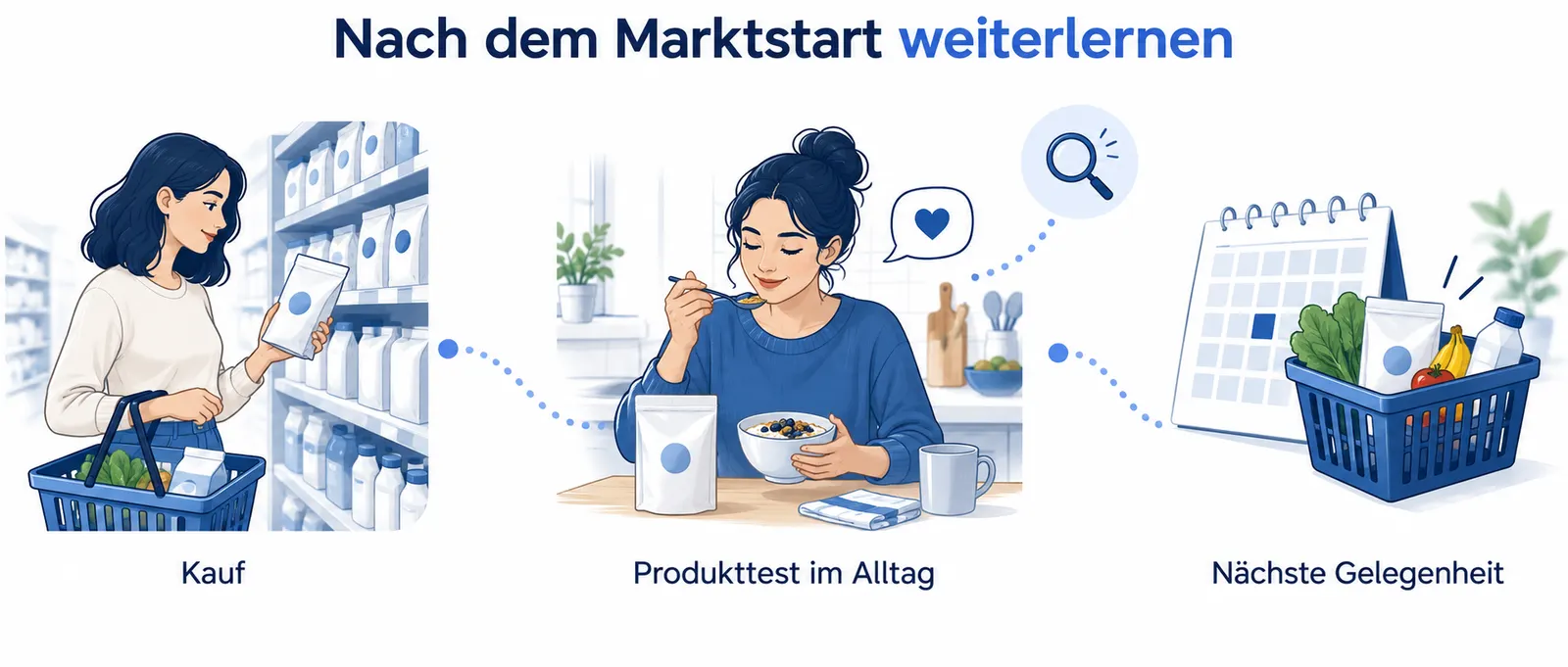
Image description and translated labels
Keep learning after launch. Purchase: confirm a qualifying transaction; Everyday product trial: ask targeted questions about use and experience; Next opportunity: observe another purchase within the appropriate window. Schematic illustration without performance values.
2. Three business questions before momentum is lost
A manageable launch does not need another collection of metrics. It needs signals for decisions: where is the obstacle? What can change? And when will it become visible whether the change helps?
Can the product be bought where demand is meant to arise?
A listing is a prerequisite, not a complete view of the shelf. Distribution, availability, placement and PoS execution show whether the planned launch reaches the market locally. If the product is missing or placement is wrong, execution is corrected first rather than prematurely rejecting the product idea.
Does the product experience deliver on the relevant promise?
A confirmed purchase shows purchasing behaviour. It does not automatically show whether, when or how the product was consumed. This requires targeted Buyer Signals on consumption occasion, usage context, purchase motivation and relevant substitutes, tailored to the product, segment and growth question.
These signals help diagnose a problem: is a suitable usage idea missing? Is the benefit unclear? Or does the product fulfil a different task than assumed in the launch plan? The answer sharpens communication, activation and, where needed, product development.
Does a next purchase opportunity arise, and is it taken?
The second opportunity follows buyers’ everyday lives, not the campaign calendar. A suitable prompt can make the product relevant again, with a usage idea, reminder or specific occasion.
A click alone does not show whether this succeeds. What matters is observed follow-up purchases and the interval between purchases, insofar as the chosen setup records them. Repeat participation with purchase evidence is a purchase signal; a response to a message initially remains a response signal.
These questions need not run sequentially. Their timing follows category, distribution and usage rhythm. A late launch review thus becomes an earlier opportunity to adjust.
3. Turning signals into next steps
The following overview translates the three business questions into possible actions. It is a decision approach, not a blanket benchmark.
Wide tables can be scrolled sideways.
Business question | Observable signal | Possible next step |
|---|---|---|
Does the launch reach the shelf? | Availability and placement at the PoS | Correct execution or stock before assessing demand. |
Does the product experience hold up? | Purchase evidence plus Buyer Signals on use, motivation and substitutes | Test a usage idea, communication or activation purposefully. |
Does repeat purchasing emerge? | Another confirmed purchase and the interval between purchases | Adjust prompt and timing; assess impact within the appropriate measurement window. |
For every review point, define the hypothesis, data source, owner and next decision time in advance. Not “We are monitoring the launch”, but, for example, “We are testing whether a clearer usage idea supports the next purchase.”
The growth question also matters: does the launch win new buyers for the brand or category, or mainly shift existing purchases? Repeat purchasing is important, but does not replace ongoing buyer acquisition. Sales, margin and retail data help interpret economic contribution; it cannot be inferred from dialogue responses alone.
Data from active buyers provide specific insights into use, communication and further tests. How far these findings can be transferred to other buyers depends on the group reached and the use case. Confirmed follow-up purchases show the return observed within the configured mechanism. A purchase outside this mechanism may remain invisible.
Wide tables can be scrolled sideways.
Finding | Possible explanation | Next check | Possible action |
|---|---|---|---|
Low shelf availability | Gaps in distribution or replenishment | Check availability and placement in target stores | Improve retail execution before expanding activation |
Few purchases despite good availability | Visibility, purchase incentive or product promise are not strong enough | Assess sell-out, promotional visibility and purchase barriers together; a few dialogues alone do not explain demand | Test activation or messaging purposefully |
Good initial use, few observed follow-up purchases | Gaps in purchase opportunity, everyday relevance or measurement | Check buyer feedback, measurement window and follow-up purchase evidence | Test a usage idea or timing; add measurement |
SKU grows, category barely develops | Purchases shift within the assortment | Analyse category sales, economic return and comparison stores | Assess placement and activation by additional category contribution |
4. How DiALOGiFY builds launch momentum
The Customer Momentum System approach connects the view of the shelf with activation, Buyer Signals and the next relevant step. Rather than analysing visibility, promotion and follow-up separately, it creates a connected picture the team can act on.
Retail Visibility: in the six-month Launch Momentum programme described, Scoutsss Launch Control checks distribution, placement, Share of Shelf and promotion execution in three waves. Review timings are aligned with the launch phase and retail execution. This reveals where purchasing conditions are in place and where improvements are needed.
Business Initiatives: a specific activation supports purchase. Instant Cashback through TWINT combines a fixed, guaranteed cashback for valid participation with a planned repeat purchase nudge for participants with the required communication permission. Participation, dialogue and redemption take place in the TWINT app; no additional campaign app is needed. An individual product code is the preferred entry point. If per-unit labelling is impossible, a receipt check can be provided as an alternative mechanism.
Buyer Signals: a short, voluntary dialogue provides context on purchase and use. Purchase evidence confirms the purchase; the dialogue adds the buyers’ perspective. Together, they reveal which needs, motivations and barriers matter for the launch.
Touch Journeys and Nudge Flows: the always-on journey accompanies buyers until the next purchase opportunity and continues after the project ends. Nudge Flows shape follow-up contacts around Buyer Signals, occasion, purchase interval and consent.
Growth Cockpit: the Launch Impact Report brings together the programme’s available PoS, activation and repeat purchase data for the retail discussion. Specific Next Best Actions show which placements, activations or follow-up contacts should be adjusted, tested or scaled.
The elements are adapted to the launch phase and most important growth question. DiALOGiFY combines software with Managed Execution; services, data connections and automation scope are defined for the specific programme.
Scroll the figure sideways or open the enlarged version.
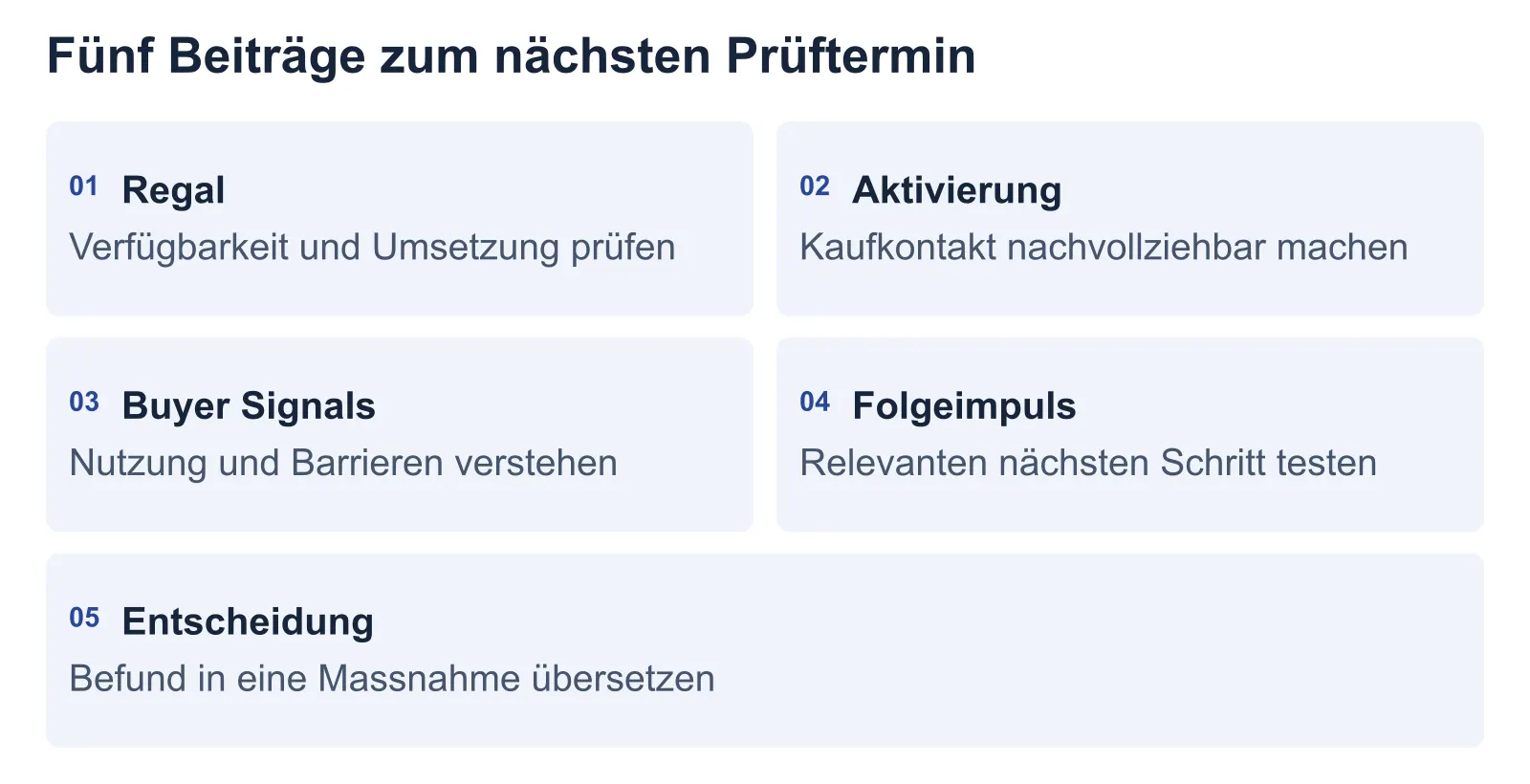
Image description and translated labels
Five contributions to the next review date. Shelf: assess availability and execution; Activation: make purchase contact traceable; Buyer Signals: understand use and barriers; Follow-up prompt: test a relevant next step; Decision: translate findings into action. Schematic illustration without performance values.
5. More business from the launch budget
The value of this connection is not more reporting. It is developing more business from an expensive launch and recognising earlier where budget is having no impact.
Connect buyer acquisition with a follow-up path. The first purchase is not the last planned contact; suitable usage ideas and repeat purchase prompts can support the next opportunity.
Make more targeted adjustments. Availability, product understanding and a missing occasion each require different next actions. Diagnosis helps invest budget where it can actually change something.
Build substantive retail arguments. PoS observations, confirmed purchases and Buyer Signals provide different, complementary arguments for launch and assortment discussions.
Reuse insights. What a launch reveals about use, substitutes and responses improves the next activation and the next innovation.
A repeat purchase prompt is tested as a hypothesis during launch. Whether it works is shown by later purchases within the intended observation window and a suitable comparison basis.
6. Nine questions for the next launch discussion
These fields can be completed directly for your next specific use case. Add an owner and a deadline for every open point.
Wide tables can be scrolled sideways.
Question | Status and next step with review date |
|---|---|
Can we distinguish planned and actual availability? | Clarified or to be checked: |
Do we separate reach, participation, confirmed purchase and reported use? | Clarified or to be checked: |
Do we know which participants are genuinely new to the product or brand? | Clarified or to be checked: |
Do we know the relevant consumption occasion and main substitutes? | Clarified or to be checked: |
Has the first useful repeat purchase window been defined? | Clarified or to be checked: |
Do we count only another evidenced purchase as repeat purchase, and responses separately? | Clarified or to be checked: |
Is there a relevant, permitted follow-up path and rules for frequency and taking no action? | Clarified or to be checked: |
Does the team know which action is checked for which signal? | Clarified or to be checked: |
Have data source, comparison basis, ownership and next decision time been clarified? | Clarified or to be checked: |
7. What remains after the peak
Attention can be bought. A product must earn a lasting role in everyday shopping. Whether it succeeds depends on its benefit, availability and the next real purchase opportunity.
A launch system cannot make a weak product strong through calculations. But it can reveal earlier what works, activate buyers more purposefully and support the next purchase.
The next review point needs only a clear connection: an observed gap, an owner, a targeted action and a date for the next decision.
Next step: find the biggest momentum gap
Where does the launch lose the most potential today: at the shelf, first purchase, use or the next purchase?
Launch Momentum is DiALOGiFY’s six-month programme for these transitions. In the Discovery Call, we clarify launch phase, available data and the main momentum gap as the basis for the specific service scope.
Sources
Promarca (2025). Annual Report 2024. New branded products from member companies in Switzerland.