
WHITEPAPER | DiALOGiFY
The true cost of sampling
A fair comparison of physical, digital and hybrid approaches
For trade and shopper marketing managers in Swiss FMCG
The key decisions
- The right sampling approach follows the purchase barrier and the desired outcome.
- Cost per sample, confirmed purchase and repeat buyer answer different questions.
- A robust comparison connects full costs, the same outcome denominator and a transparent basis for comparison.
The examples are schematic planning aids. They do not show achieved customer results.
Everything distributed. But what was gained?
The last samples have been handed out, the promotion is over and the pallets are empty. The closing report lists volume, reach and cost per contact. On paper, the campaign was successful. Then comes the question no distribution report answers: who actually tried, bought and returned?
Distribution can create a product experience. But it neither confirms a purchase nor explains who bought later or what happened afterwards. If the promotion should answer these questions too, it needs additional data collection and a planned follow-up. The distribution report alone is not enough.
Physical sampling has a clear task: it makes taste, scent, texture or use directly tangible. If this experience resolves the main purchase barrier, it can be the right approach. But once the growth question goes beyond trial, the number of samples distributed is not enough. Research shows that channel, design, store and observation period influence impact; distribution alone does not explain business value.
A low price per sample distributed can therefore come at a high cost. It shows neither the full investment needed for a verifiable outcome nor the lost value when the contact creates no buyer knowledge and no targeted next step. The better cost question is: what was invested, and what was actually gained?
Digital Sampling with Instant Cashback from DiALOGiFY starts with a real purchase. It connects purchase confirmation within the mechanism, voluntary Buyer Signals and a planned repeat purchase nudge. Alongside participation, the intended follow-up can thus be observed. Whether this approach is more economical than physical or hybrid sampling depends on the objective, full costs and jointly defined outcome.
Three questions that determine business value
This whitepaper shows when physical, digital or hybrid sampling fits the actual growth question; how to compare costs up to a verifiable outcome rather than just distribution; and how purchase confirmation, Buyer Signals and a targeted next prompt turn sampling into a measurable learning and repeat purchase approach.
1. From sample to measurable business value
The number of samples distributed is easy to record, but shows only the promotion’s immediate output, not its business value.
Several transitions lie in between: a distributed sample is not automatically a product experience, that experience is not yet a confirmed purchase, and a confirmed purchase is not yet a repeat purchase. Even an observed repeat purchase does not establish incremental impact without a suitable comparison basis.
That is why not only production and distribution costs matter, but the entire investment up to a confirmed outcome, the insights gained from it and the possible next step.
A randomised field study with 1,630 households compared in-store, direct-mail and online-request sampling for an oral care product and followed acceptance, use, purchase conversion and engagement over 18 months. The channels produced different patterns. Earlier store and field experiments likewise show that physical sampling can influence sales, but impact and profitability vary by store, design and over time.
The better question is therefore not only: what does a sample cost? But: what does a verifiable outcome cost, and what is the cost when the contact provides no usable insight and no targeted next step?
2. What sampling must achieve economically
Before comparing formats, the programme needs a primary job. Four tasks are particularly often confused.
Enable product experience
Taste, scent, texture, use or performance should become tangible. If the main barrier is sensory or requires explanation, physical sampling may be an appropriate first answer.
Key question: how many relevant people actually experienced the product under appropriate conditions?
Confirm a purchase within the mechanism
In a purchase-linked activation, the person chooses at the shelf, pays for the qualifying product and then fulfils the campaign rule. What becomes visible is a confirmed purchase within the mechanism, not automatically that person’s first-ever purchase.
Key question: how many unique purchases were confirmed according to the campaign rule?
Obtain Buyer Signals relevant to decisions
The activation connects the confirmed purchase with a few relevant Buyer Signals, such as motivation, consumption occasion, usage context and alternatives considered. Selection follows the product and the specific growth question. Immediately after purchase, the dialogue can ask when the product is intended to be used and which alternative would otherwise have been chosen. These voluntary answers complement observable events. They provide insights for communication, positioning and the next useful contact.
Key question: which signals are generated, how were they collected and for which purpose may they be used?
Make the next step measurable
An appropriately timed next prompt can be tested as an intervention. It is not a promise of results. Repeat purchasing only becomes meaningful when population, starting point, observation window and comparison basis are defined in advance.
Key question: which next action should be triggered and which follow-up event should be observed reliably?
Sampling becomes a growth system when product contact, confirmed purchase, relevant Buyer Signals and a measurable repeat purchase approach are connected.
3. Comparing three sampling architectures
Physical, digital and hybrid sampling are not interchangeable production methods. They serve different tasks and allow different forms of evidence.
The three approaches compared
Wide tables can be scrolled sideways.
Criterion | Physical sampling | Digital Sampling with DiALOGiFY | Hybrid |
|---|---|---|---|
Primary value purchased | Product experience, advice and an experience at the point of sale | Purchase activation plus digital learning and repeat purchase approach | Product experience plus digital follow-up |
Product experience without a prior purchase | Advantage: immediate trial without a purchase decision | Purchase or participation is part of the mechanism | possible through an integrated physical sample |
Purchase within the mechanism can be confirmed | only with additional verification logic | part of the confirmed campaign setup | with a properly connected setup |
Buyer Signals | only with additional data collection | can be integrated into the journey | can be integrated through digital follow-up |
Permitted follow-up contact | identification and permission required separately | can be planned within the confirmed permission model | possible through digital follow-up |
Repeat purchasing and learning | additional infrastructure required | observable within an established repeat purchase approach | possible with a connected setup; transitions must be managed |
Typical main use | sensory barrier or need for explanation | measurable purchase, learning and repeat purchase approach | combination of both objectives |
Key limitation | without an additional mechanism, the direct trail often ends after distribution | records only events within the mechanism | more transitions and drop-off points |
The approach alone does not determine how much the evidence can tell you. What matters is which events are actually recorded and how product contact, purchase verification, voluntary information and permitted follow-up contact fit together.
Selection follows the primary task: physical sampling fits when immediate product experience is decisive. Digital Sampling starts with purchase and connects it with voluntary Buyer Signals and the intended repeat purchase prompt. Hybrid can combine both tasks. Which approach offers the greatest business value is revealed by a comparison using the same cost framework and an appropriate shared outcome denominator.
DiALOGiFY connects purchase, learning and repeat purchasing
At DiALOGiFY, Digital Sampling refers to the Instant Cashback use case for physical products. Consumers buy a qualifying product and start the dialogue through the individual product code in the TWINT app. With valid participation, they receive a predefined, fixed and guaranteed cashback payment within TWINT. No additional campaign app or campaign account is needed. The standard includes a planned repeat purchase nudge for participants with the required communication permission; its timing follows the product and the intended communication framework.
Individual product codes support purchase checks and the defined participation limits. Which qualifying events can be linked across multiple participations depends on the campaign setup. If individual labelling is impossible, a receipt can be checked. Required information and participation conditions remain part of the dialogue. The conditions and verification logic define which events are recognised.
The product advantage lies in connecting the real purchasing moment, relevant Buyer Signals and a measurable next step.
4. An evidence map instead of an artificial funnel
The three approaches do not automatically pass through the same stages. Instead of artificial comparability, an evidence map shows which event can actually be observed for each approach.
Possible events
made available or distributed: supported by production, stock, logistics or point-of-sale data
product experience: observed on site, self-reported after use or merely plausible
purchase confirmed: a qualifying purchase was confirmed according to the campaign rule
system event: for example dialogue completion or payout
Buyer Signal: voluntary information or observable behaviour within the journey
permission-based contact: follow-up communication is permitted within the confirmed scope
further purchase: a later qualifying transaction was linked within the approved measurement and data protection model
Four specifications for every rate
Numerator: which event is counted?
Denominator: which population does the rate refer to?
Observation window: from which point and for how long is measurement conducted?
Evidence type: is the event verified, observed by the system, self-reported or modelled?
Scroll the figure sideways or open the enlarged version.
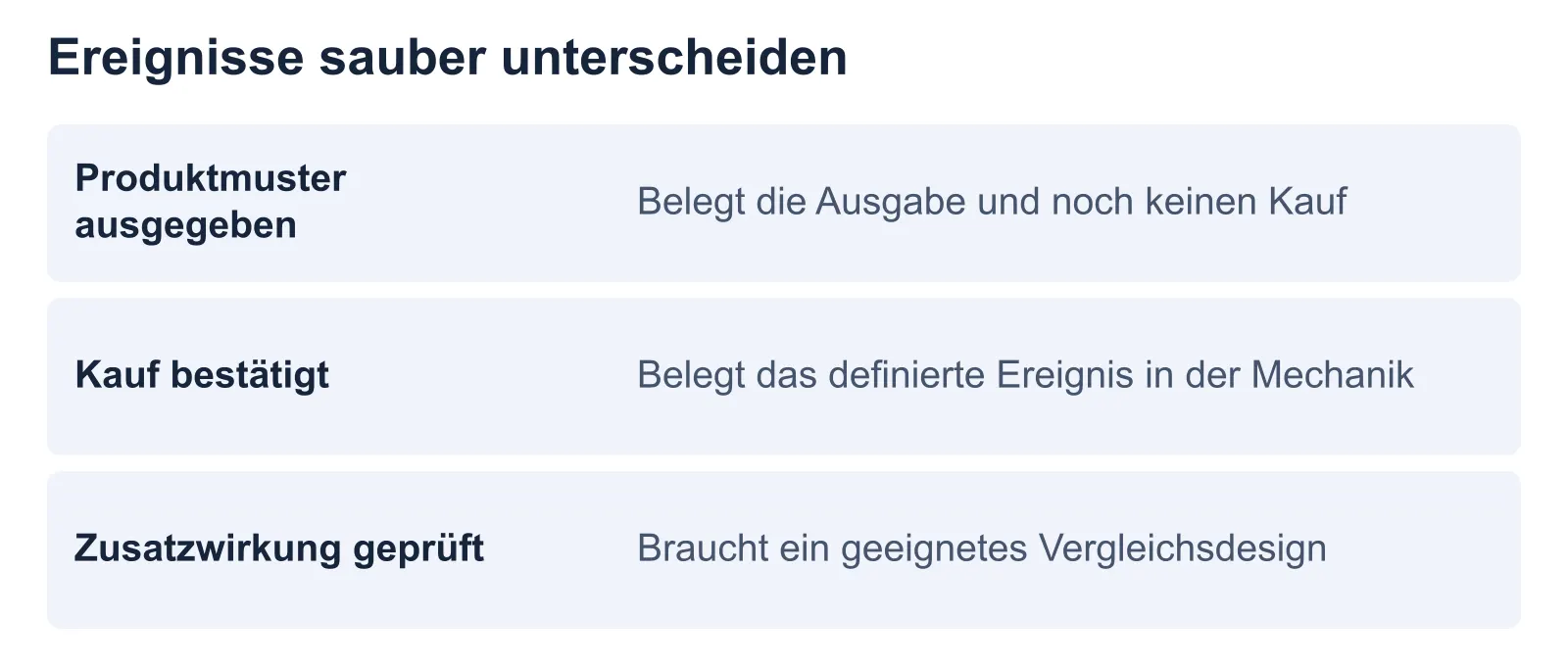
Image description and translated labels
Distinguish events clearly. Sample distributed: confirms distribution, not yet a purchase; Purchase confirmed: confirms the defined event within the mechanism; Additional impact assessed: requires an appropriate comparison design. Schematic illustration without performance values.
This distinction prevents two common mistakes: self-reported repeat purchase intention is not an observed repeat purchase. And another observed purchase does not prove incremental impact without a baseline.
5. The true cost across three cost layers
A fair comparison uses the same cost framework for all approaches: only costs actually incurred, but including all relevant efforts beyond the product invoice.
With Instant Cashback, refunds are paid for valid participations. Other costs include labelling, setup, purchase verification, support and analysis. Physical sampling includes samples, staff, space and logistics, among other costs. A cost comparison only becomes meaningful when both approaches address the same task and their outcomes are recorded comparably.
What matters is the usable outcome per franc invested.
What does the contact cost?
Product, special sample sizes, packaging, stickers, codes, minimum quantities, changeovers and production surcharges
Staff, stand, permits and retailer or space costs
Transport, storage, handling, returns, rejects, spoilage and disposal
Media support and operational reach generation
This layer explains the cost of encountering the activation. It says nothing yet about outcome quality.
What does a verifiable outcome cost?
Project time, agency, campaign setup, creative work and technical setup
Incentive or cashback actually paid, plus discount and margin effects
Purchase verification, abuse checks, exceptions and consumer support
Journey, data collection, data cleaning, reporting and follow-up and CRM costs actually incurred
Test design, comparison group, governance, human legal review and possible cannibalisation effects
This layer reveals the investment needed to turn contact into robust evidence.
What does the missing next step cost?
An unused learning trail: it remains unclear who responded and why.
A missing next step: no permitted further action is planned after the contact.
Measurement that cannot support a decision: reach or redemptions do not allow a scaling decision.
An unsuitable approach: the budget does not address the actual purchase barrier.
Scroll the figure sideways or open the enlarged version.
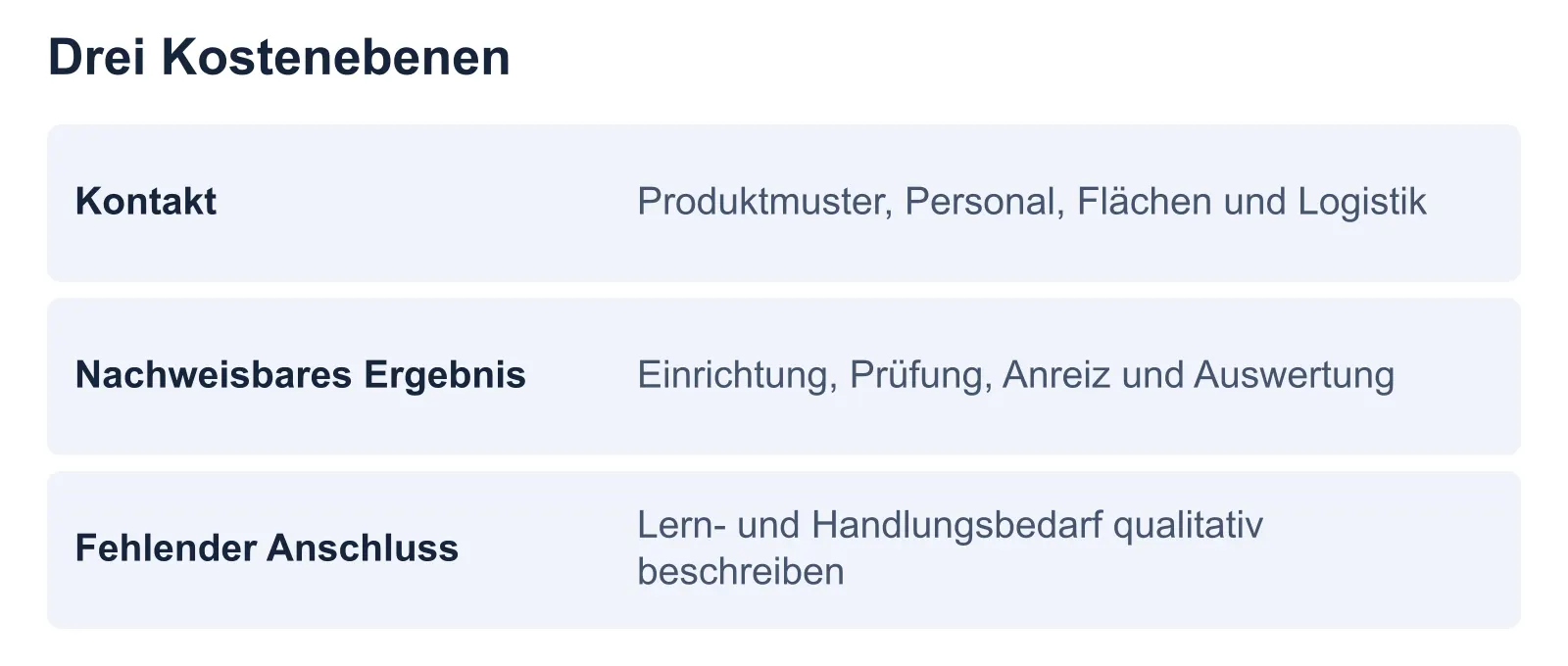
Image description and translated labels
Three cost layers. Contact: samples, staff, space and logistics; Verifiable outcome: setup, verification, incentive and analysis; Missing follow-up: describe learning and action needs qualitatively. Schematic illustration without performance values.
These opportunity costs are described qualitatively. Without robust comparative data, they must not enter the calculation as an invented monetary amount.
The right denominator
Cost per sample distributed = K / samples distributed
Cost per observed product experience = K / observed product experiences
Cost per confirmed purchase = K / purchases confirmed according to the campaign rule
Cost per permission-based contact = K / unique contacts with valid permission
Cost per observed repeat buyer = K / unique people with at least one further confirmed purchase within the defined window
If a stage cannot be measured, its value remains unknown. K includes activation, evidence and follow-up costs actually incurred; opportunity costs belong in the calculation only if they can be quantified reliably.
Purchase-linked sampling avoids a specific form of wasted reach: cashback is tied to a qualifying purchase. This removes free product distribution to passers-by whose actual interest and subsequent use often remain unknown. At the same time, purchase evidence and the opportunity for direct dialogue are created. What share of purchases was caused additionally is a separate economic question.
A comparison using the sampling calculator’s logic
Illustrative planning scenario with 10,000 campaign products or samples per approach. All amounts and rates are adjustable model assumptions, not market benchmarks or binding prices. Additional costs are set at CHF 0 in this example. Before a budget decision, check further items against the specific quotation and internal effort. Both approaches use CHF 1.20 contribution margin per verified product sold, before the incentive included separately.
Household sampling: CHF 0.50 production cost per sample and 5% additional samples for wastage give CHF 5,250. Distribution at CHF 0.45 per sample and CHF 4,000 project workload give CHF 8,500. Assuming 1% purchase-linked coupon redemption and a CHF 0.60 coupon, coupon costs are CHF 60. Total costs CHF 13,810, 100 confirmed purchases, CHF 138.10 per confirmed purchase. After CHF 120 credited contribution margin, remaining expenditure is CHF 13,690.
Instant Cashback: assumptions are CHF 18,000 for delivery, CHF 0.10 sticker costs per campaign product, CHF 4,000 fixed TWINT costs and CHF 2 cashback per valid redemption. At an assumed 10% redemption rate, this produces 1,000 confirmed purchases. Total costs CHF 25,000, CHF 25 per confirmed purchase. After CHF 1,200 credited contribution margin, remaining expenditure is CHF 23,800.
In this scenario, Instant Cashback has higher total costs and lower costs per confirmed purchase. The comparison makes the decision visible: how much budget is available, which evidence is needed and how do different redemption rates change the result? Product experience and buyer knowledge are additional benefits assessed separately. Crediting contribution margin shows expenditure after observed sales. The following calculation box calculates causal ROI using additionally generated units.
6. Calculation box: break-even and ROI without false precision
Retail price is not contribution margin. Dividing campaign costs by selling price does not calculate economic break-even for the brand.
A working calculation requires at least three quantities:
K = activation, evidence and follow-up costs actually incurred within the defined cost framework
D = net contribution margin per incremental unit
I = additional units compared with a robust baseline or control group
Break-even units = K / D
Campaign ROI = (I × D − K) / K
The calculation is only reliable if:
I is genuinely incremental and not merely observed,
period and comparison basis are fixed,
cannibalisation is taken into account,
the incentive or discount is included exactly once, either in K or already in net contribution margin D,
all other relevant costs are included in K.
Customer Lifetime Value is not shorthand for “retail price times assumed purchases”. Without a defined customer unit, margin, period and behavioural assumptions, “observed contribution margin during the period” or “potential revenue” are more precise terms.
An illustrative calculation with freely chosen values
The following figures are illustrative assumptions, not market benchmarks or DiALOGiFY prices. Cashback or discount is included exactly once in K or D.
Wide tables can be scrolled sideways.
Quantity | Assumption or calculation |
|---|---|
Total costs K | CHF 10,000 |
Net contribution margin D | CHF 2 per additional unit |
Break-even | 10,000 / 2 = 5,000 additional units |
Additional units I | 6,000 compared with a suitable comparison basis |
Campaign ROI | (6,000 × 2 − 10,000) / 10,000 = 20% |
If 6,000 units were merely observed and their additionality was not established, a causal campaign ROI of 20% cannot be inferred.
Applied to the Instant Cashback scenario above: at CHF 25,000 total costs and CHF 1.20 net contribution margin per additional unit, break-even is 20,834 additionally sold units, rounded up. ROI is (additional units × CHF 1.20 − CHF 25,000) / CHF 25,000. These units may come from first and follow-up purchases within the defined measurement period. The 1,000 expected redemptions alone are insufficient to determine additionality. Buyer knowledge and permitted follow-up contacts are reported separately as further outcomes.
7. The sampling decision check
Eight questions should be answered before choosing a format:
Which business decision should be made after the activation?
Which sampling job takes priority: product experience, confirmed purchase, Buyer Signals or repeat purchasing?
Which audience should be reached in which selling, purchasing or consumption moment?
Which barrier must the first product contact overcome?
Which events can the chosen approach actually substantiate?
Which costs belong in the shared full-cost framework?
Which comparison basis and observation window make the outcome useful for decisions?
Which outcome leads to scaling, adjustment or stopping?
Without these answers, a calculator is premature. Once they are clear, it makes assumptions transparent, but replaces neither data nor decision criteria.
Sampling calculator for your own planning
On our resources page, the sampling calculator complements this decision check. It makes the assumptions of a specific cost comparison transparent. Use the same cost framework and outcome denominator as in the cost sheet. The result depends on the assumptions entered.
Open the sampling cost calculator
Cost sheet for the shared comparison
Working template for your cost comparisonCopy the cost sheet into your planning document. For each item, record the total amount with its quantity or period and identify the source as a quote or assumption. Add an owner and a deadline for open points. Define the shared comparison basis separately below the table.
Wide tables can be scrolled sideways.
Cost item | Amount in CHF and reference unit | Source or assumption |
|---|---|---|
Product and labelling | CHF [total amount] for [quantity/period] | Source: [quote/assumption] |
Staff, space and logistics | CHF [total amount] for [quantity/period] | Source: [quote/assumption] |
Setup, creative work and project time | CHF [total amount] for [quantity/period] | Source: [quote/assumption] |
Cashback or other incentive | CHF [total amount] for [quantity/period] | Source: [quote/assumption] |
Verification, support and analysis | CHF [total amount] for [quantity/period] | Source: [quote/assumption] |
Follow-up contacts and measurement | CHF [total amount] for [quantity/period] | Source: [quote/assumption] |
Total costs K | CHF [total amount] for [quantity/period] | Source: [quote/assumption] |
Shared confirmed outcome
This comparison basis is not a cost item and is not recorded in CHF. Use the same outcome type and period for both options and record the number of confirmed outcomes.
- Outcome type
- [Shared definition]
- Number
- [Confirmed outcomes]
- Period
- [Start to end]
8. DiALOGiFY connects purchase, learning and repeat purchasing
DiALOGiFY starts where sampling should deliver more than reach or product distribution: on the path from a confirmed purchase within the mechanism to the next measurable decision.
Digital Sampling with Instant Cashback can connect three elements in one activation approach:
a confirmed purchase according to the campaign rule,
voluntary Buyer Signals from the digital journey,
a measurable next step with appropriate measurement points.
This reveals who responds within the activation, what context the voluntary information provides and which follow-up action is tested. To decide whether to scale or stop, these observations are assessed using the measurement and comparison logic defined in advance.
DiALOGiFY suits tasks that should bring together purchase confirmation, buyer understanding and planned follow-up. The Discovery Call clarifies the objective, mechanism, measurement model, responsibilities and decision criteria.
Which participations can be linked over time and which data may be used are defined for the campaign. Recognition and permission for further communication are treated separately. An optional CRM integration requires its own agreed scope.
Conclusion
Physical sampling creates immediate product experience. Digital Sampling with Instant Cashback from DiALOGiFY starts with purchase and connects it with voluntary Buyer Signals and a planned repeat purchase nudge. Hybrid can combine product experience and digital follow-up. The appropriate approach follows the purchase barrier, outcome objective and full-cost comparison.
Comparing unit costs alone compares production methods. Connecting confirmed purchase, insight gained and repeat purchase logic compares business value.
The true cost is not decided by the sample alone. It emerges from the relationship between full expenditure and the outcome the chosen approach can actually substantiate.
Next step
Three starting points are enough for a shared discussion: the planned activation’s objective, the full-cost framework and the events that can be substantiated today. Together, these provide a basis for identifying the approach that offers the most reliable path from activation to the next decision.
About DiALOGiFY
DiALOGiFY develops the Customer Momentum System for FMCG and retail brands. It connects retail execution and the point of sale with verifiable activations, voluntary Buyer Signals, relevant follow-up contacts and repeat purchase measurement. DiALOGiFY AG is based in Zug, Switzerland.